FORRU-CMU Small Student-Project Support Grants - 2026
Language:
FORRU-CMU is supporting field costs of three BSc special projects this year. Two focus on forest tree phenology, whilst the third will study the growth of wildlings—seedlings dug up from the forest, as an alternative to producing planting stock from seeds.
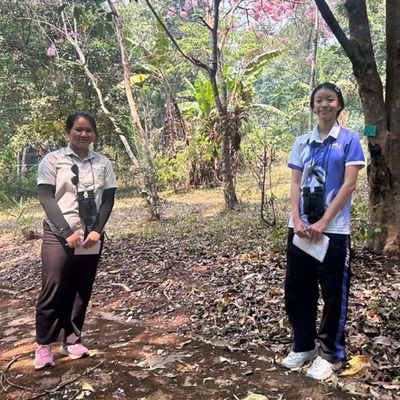
Miss Waralee Vijitpunya and Miss Banthita Sirinil - 2026 FORRU grantees.These two BSc Special Projects are being conducted by Miss Waralee Vijitpunya and Miss Banthita Sirinil. Together, they will investigate seasonal changes in the reproductive and leafing phenology of nine selected tree species in evergreen forest on Doi Suthep. Waralee will focus on: Ficus benjamina, Magnolia baillonii, Styrax tonkinensis, Sapindus rarak and Acronychia pedunculata, whilst Banthita will study: Garcinia mckeaniana, Baccaurea ramiflora, Cryptocarya amygdalina and Morus macrouraKey phenological stages, including leaf flushing, flowering and fruiting will be scored semi-quantitatively, to reveal species-specific seasonal patterns. Field data will be collected monthly and compared with FORRU's historical records, to provide insights into plant–climate relationships, particularly the potential impacts of climate change on forest ecosystems. The findings are expected to support forest conservation and restoration planning, as well as sustainable resource management. Furthermore, the research will contribute to ecological knowledge of Doi Suthep's indigenous tree species, and provide valuable baseline data for future ecological studies.