


Vientiane, Lao PDR — On February 9 th to 10 th 2026, the Amari Hotel Vientiane became a hub of environmental strategy development, as stakeholders gathered for a critical "Forest Policy Dialogue on Forest Restoration", organized by the Protection and Sustainable Use of Forest Ecosystems and Biodiversity (ProFEB) project—a joint initiative of the Governments of Lao PDR, Germany and the European Union. The Dialogue aimed to devise effective policies to expand forest cover to 70% of the country by 2035.
Dr. Somvang Phimmavong (Director General of the Lao PDR Department of Forestry) opened the event by focusing participants’ attention on the issue of where to restore. He said that planting trees is the easy part. The real work lies in zoning issues and pre-securing land tenure.
Ms. Veerle Smet (EU Delegation) added that sustainable value chains and biodiversity conservation are both essential for social development when implementing restoration.
H.E. Hans-Ulrich Südbeck (German Ambassador) provided an international perspective, stating that Germany recognizes restoration as a global priority, as it addresses the shared challenges of climate change, drought and flood prevention and the proliferation of unsustainable forestry practices.
Opening remarks concluded with a video message from the UN Decade on Ecosystem Restoration, which focused on another theme which recurred through the event: "The biggest barrier to scaling up is the financing gap."
The morning proceeded with two scene-setting talks. Manoly Sisavanh (Wildlife Conservation Society) presented an inspirational talk on the local setting for restoration action. “Nature is deeply ingrained in Lao society”. She asked participants to incorporate local knowledge when planning restoration.
Xaysompheng Sengkhamyong outlined Lao PDR’s national goal to expand forest cover to 70% of the country, whilst absorbing 55 million tCO2 to meet national climate goals. The 2035 restoration targets are: i) natural restoration/natural regeneration 1.3 million ha (biodiversity and climate-change mitigation), ii) planting trees for environmental protection, 100,000 ha (mostly watershed services) and iii) commercial tree plantations, 400,000 ha. However, attaining these targets is currently threatened by agricultural expansion and infrastructure encroachment. The plan prioritizes forest rehabilitation and private-sector plantations, to balance ecosystem services with livelihood support for over 3,000 forest-dependent villages.
A panel of distinguished experts then debated some of the key issues with compiling a national restoration plan. When each panelist was asked to identify a single most critical action, they came up with:
- Lao PDR still struggles with land-use planning; the solutions are non-linear (Dr. Somvang Phimmavong)
- Land use planning and clear demarcation (Cecile Leroy, EU Delegation)
- Decentralize actions—have a national strategy, but let the people who work the land come up with ideas (Mamadou Diakhite, Manager of AFR 100 Partnership).
- Identify restoration hotspots, coupled with effective cost-benefit analysis: “how do we ensure investors believe the figures?” (Ilias Animon – UN Food and Agriculture Organization).


Jake Brunner (IUCN) argued that 30 years of theoretical modeling of where to perform restoration has failed, due to high transaction costs, insecure tenure and the financial impossibility of smallholders waiting 15 years for returns. He advocated shifting focus from fragmented smallholder projects to State Forest Companies, to achieve scale and reduce transaction costs. He advocated planting native forest tree species as a “key opportunity” to leverage carbon/biodiversity credits and recommended the use of the numerous recently developed tools, including IUCN’s ROAM (Restoration Opportunities Assessment Methodology) and various phone apps (e.g. MyFarmTrees etc.) to secure community collaboration.
Pieter du Plessis (Lao Integrated Forestry Solutions (LIFS)) recommended private-sector industrial plantations, but with integrated conservation safeguards, which he contends could transform Lao PDR into a leading timber producer globally. Timber companies already implement conservation measures, such as wildlife corridors, assisted natural regeneration, elephant conservation and the protection of karst landscapes, all of which link to job opportunities in ecotourism. He emphasized the need for clear regulations, strict safeguards and independent monitoring of industrial plantations, to secure investments.

The second day kicked off with another four “lightening talks”, which further “electrified” the audience.
Alexis Corblin (UNEP Asia-Pacific) argued that the national 70%-forest-cover target lacks the data necessary to measure ecosystem quality and resilience. Currently, Lao PDR’s National Forest Monitoring System (NFMS) focuses on area metrics, rather than biodiversity or ecological outcomes. He identified the need to distinguish “restoration” from “reforestation” and to shift the emphasis of monitoring from "hectares planted" to indicators such as, connectivity and ecosystem integrity. He also put forward UNEP’s tool: the Forest Restoration Impact Monitoring Framework (FRIMF) as a potential solution (https://resources.unep-wcmc.org/products/WCMC_RT748).
Stephen Elliott (FORRU-CMU) then talked about the need for massive technical capacity building, as the foundation, upon which to base implementation of a national restoration strategy. He also identified lack of a national seed-collection, storage and distribution network, as a major infrastructure item, currently lacking, without which actual on-the-ground ecological restoration would be severely limited.
Joel Persson (University of Bern) then presented results of a survey of various restoration stakeholders. Consensus among them centered around prioritization of local stakeholder involvement, integration of traditional knowledge and focus on generating Non-Timber Forest Products (NTFPs), rather than expanding conservation areas or pursuing carbon credits. Harmonization will be needed, to reconcile differences among the various stakeholder groups on differing assumptions about causes for degradation, as well as divergent views on restoration governance and policy priorities.
Mamadou Diakhite (AFR 100, AUDA NEPAD) presented lessons learned from implementing the AFR100 initiative , which aims to restore 100 million hectares of African land by 2030 Thirty-four countries have pledged 129 Mha to the scheme, although only 30 Mha are currently undergoing restoration. He emphasized the need to transition from political commitment to measurable results. Investments must reach the local villagers instead of fueling administration.
In the afternoon, Illias Animon (FAO) gave the final presentation of the event. He focused on transitioning from broad targets to "investment-ready" projects. He suggested that Lao PDR could “leapfrog" by adapting successful models from Pakistan and Nepal, focusing on cross-sectoral coordination and clear land tenure, to overcome institutional weaknesses. He suggested that clear quantification of costs and benefits and the establishment of a transparent "Project Bank" would help to attract a diversity of investors.
Amidst the presentations, facilitator Jost Wagner skillfully interjected various innovative interactions to enable participants to identify obstacles to restoration and devise concrete policy recommendations to overcome them. Some of the frequently mentioned obstacles included:
- Insecure Land Tenure: Overlapping land claims and unclear management rights often discourage local communities from committing to long-term restoration.
- Financial Sustainability: High reliance on short-term project funding rather than stable, long-term financing mechanisms or private sector investment.
- Weak Monitoring and Data Systems: A lack of standardized tools and data leads to "blind" restoration where survival rates and ecological impact are rarely verified.
- Lack of interagency coordination: leading to conflicting land-use policies that undermine restoration goals.
- Shortage of Technical Skills: a lack of specialized technical capacity e.g. to match species with site conditions, planting stock production at suitable scales, as well as maintenance and monitoring of restored sites.
- Lack of a National Seed-Supply System: Lack of a coordinated national seed-collection program, seed banks and networked supply chains currently makes sourcing seed of a diversity of native tree species in sufficient quantities nearly impossible.
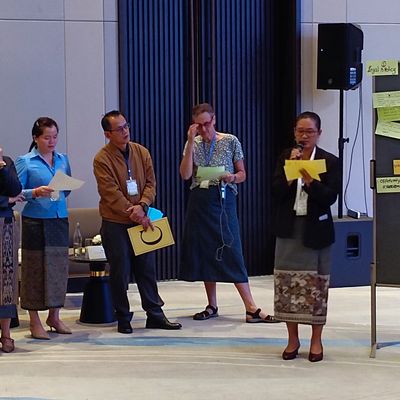

A Roadmap for Restoration Reform?
To address these hurdles, the dialogue produced a series of targeted policy advice statements in the final session. A few of the more prominent ones included:
- Legal & Policy: Clarify land-use rights to empower communities and strengthen the legal basis for restoration. Block conversion of protected areas into production forests.
- Sustainable Finances: Transition away from consolidated government revenue toward independent, transparent trustees for funds, which channel earnings from blended financing into local communities.
- Technical & Tools: introduce restoration courses into school and university curricula to match the demand for a large skilled workforce that would be generated by a national restoration program. Strengthen monitoring systems and develop a national tree seed supply network.
- Communication & Coordination: Establish an inter-ministerial task force to use TV, workshops and social media, to "communicate the business opportunities" for restoration.
- Other Recommendations: Emphasize gender equality and engage with the military to support large-scale efforts.
The Path Ahead: Restoration or Plantations?
While the dialogue generated many ideas that could support a general forestry-sector master plan for the forthcoming decade, it largely side stepped the topic of actual forest restoration (i.e. the return of forest ecosystems to their original pre-disturbance conditions). Instead, discussion groups gravitated towards plantations and agroforestry, to meet immediate economic needs. Although 1.3 million ha is earmarked for “natural restoration/ regeneration”, assisted natural regeneration (ANR) was the only technique mooted for such sites (e.g. weeding around tree saplings that might survive beneath the herbaceous vegetation that invades deforested sites). Whilst ANR can achieve tree cover, where regeneration is already advanced, re-introduction of native forest tree species is usually required, to achieve acceptable rates of carbon accumulation and biodiversity recovery, particularly where seed dispersal across landscapes is limited. FORRU-CMU’s framework species approach was not well received in discussion groups, with criticisms of it ranging from insufficient technical expertise, high implementation costs (compared with ANR) and uncertain returns on investment—Lao PDR having no domestic carbon market and poorly developed “payments for ecological services” schemes.
However, the geographical reality of Lao PDR offers cause for hope. With a human population density substantially lower (just 35/km 2 ) than that of all other ASEAN countries, the country is in a unique position to restore native forest ecosystems to pre-disturbance conditions on a scale that is no longer feasible elsewhere in Southeast Asia. Furthermore, steps are already being taken to fill the technical capacity-gap mentioned throughout the meeting. GIZ recently sent 16 key persons from its ProFEB project to Chiang Mai for a week-long training course at FORRU-CMU . Furthermore FORRU-CMU recently assisted Souphanouwong University (Luang Prabang) to develop a forest-restoration undergraduate course and to set up a research tree nursery to identify framework tree species for the region.
Although the Dialogue revealed that Lao PDR appears to be leaning heavily towards the easy choice of merely "covering 70% of its land with trees", for immediate monetary gain, there’s still time to include more actual forest-ecosystem restoration in the plan, although economists still struggle to come up with ways to deliver financial incentives directly to local communities from its less tangible benefits.